

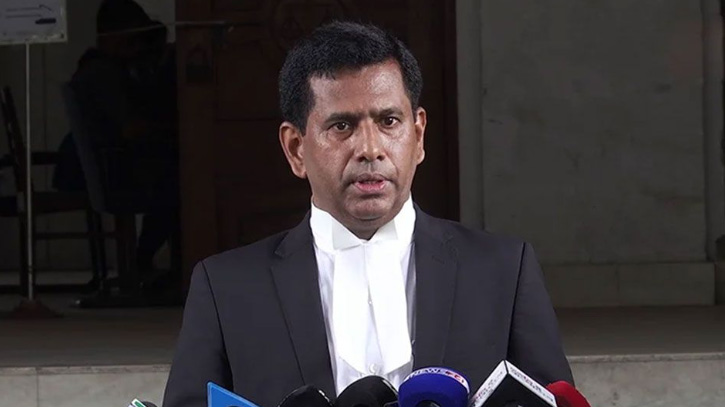

Dhaka, October 12 — Chief Prosecutor of the International Crimes Tribunal, Mohammad Tajul Islam, has said that any arrest in the enforced disappearance case involving military officers must strictly follow constitutional and legal procedures — anyone arrested must be produced before the court within 24 hours.
Speaking at a press briefing on Sunday (October 12) at the tribunal premises, the Chief Prosecutor said that the International Crimes Tribunal Act of 1973 was specially enacted to prosecute members of the army, navy, air force, intelligence agencies, police, and other disciplinary forces. The crimes being tried under this law are not defined in any ordinary Bangladeshi laws or even within the armed forces’ own legal frameworks — these are internationally recognized crimes, and therefore can only be prosecuted under this special act.
Tajul Islam further stated that the judicial process must follow the course of law. If the court authorizes detention after an arrest, the person may be held as per the court’s order; otherwise, no one can be detained for more than 24 hours without being presented before the court. This provision, he noted, is also recognized by the Constitution.
Responding to media reports about 15 army officers allegedly being taken into custody, the Chief Prosecutor clarified that the tribunal has not received any formal communication confirming their detention. “We are not considering the media reports as official information. If we are formally informed that they are in custody, they must be brought before the court within 24 hours as per legal provisions,” he said, refraining from further comment until official confirmation is received.
Emphasizing the supremacy of the tribunal law, Tajul Islam added that the International Crimes Tribunal Act—enacted to prosecute crimes against humanity, war crimes, and genocide—prevails even over constitutional provisions. “The Constitution itself recognizes this law as having higher authority. No clause of this law can be challenged in court, nor can any writ petition be filed against it in the High Court. Therefore, all trials must proceed strictly under the provisions of this special act,” he asserted.