

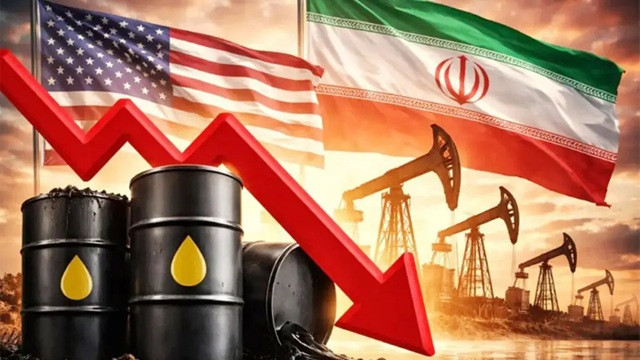

The news of a possible peace deal between Iran and the United States has had a major impact on international energy markets. Crude oil prices in the global market have fallen to their lowest level since March.
The possibility of easing tensions in the Middle East and signs of the reopening of the Strait of Hormuz have sent a positive message to investors.
At 6:04 am Bangladesh time on Monday, the price of Brent crude in the international market fell by $3.58, or 4.10 percent, to $83.75 per barrel. At the same time, the price of US benchmark West Texas Intermediate (WTI) oil fell by $4.01, or 4.72 percent, to $80.87 per barrel.
The main reason behind the fall in the oil market is seen as the progress of a possible agreement between the United States and Iran. Pakistani Prime Minister Shahbaz Sharif, the country mediating the peace talks, said that the two countries could sign a memorandum of understanding in Switzerland on June 19.
US President Donald Trump then announced in a social media post that the Strait of Hormuz would be reopened and no tolls would be imposed there. He also mentioned that the US naval blockade of Iranian ports would be lifted.
On the other hand, Iran’s semi-official Mehr News Agency reported that according to the draft agreement, the Strait of Hormuz will be reopened under Iranian supervision within the next 30 days.
According to market analysts, the uncertainty and risks surrounding the Middle East in global energy supplies are rapidly decreasing. As a result, relief has begun to return to the oil market. “Investors are now seriously considering the possibility of oil supplies returning to normal. As a result, the impact of geopolitical risks is also rapidly decreasing,” Tim Waterer, chief market analyst at KCM Trade, told Reuters.
The Strait of Hormuz, one of the world’s most important shipping lanes, carries about 20 percent of global oil and liquefied natural gas (LNG) supplies. Regional tensions have disrupted the route in recent months, putting pressure on global energy supplies. The potential agreement is believed to have eased that pressure, officials said.
Energy experts believe that if the agreement is implemented, it could bring more stability to oil prices in the international market and will also have a positive impact on the global economy.