

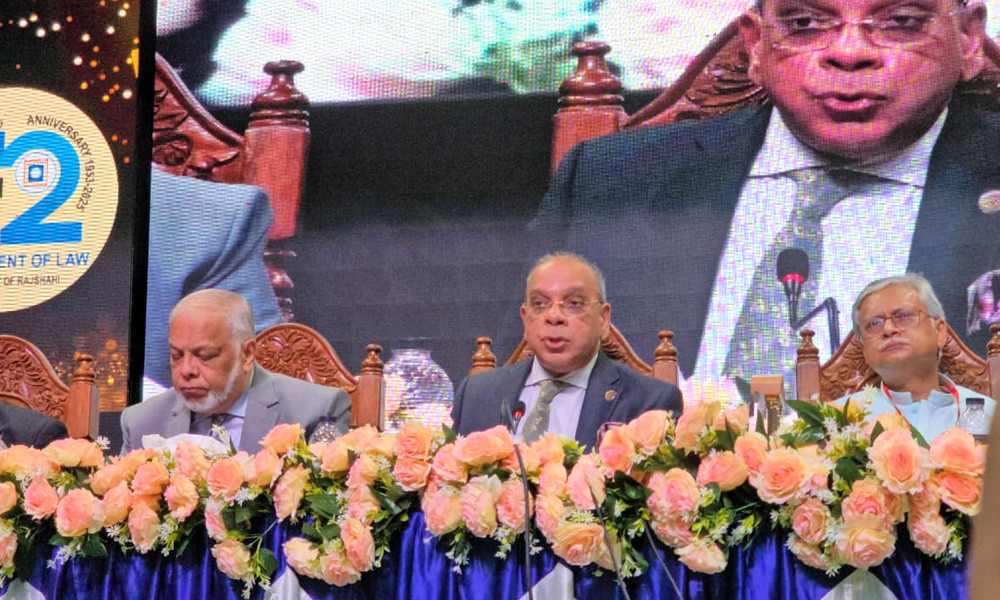

Law is not merely a set of rules; it is the reflection of a nation’s moral conscience—said Bangladesh’s Chief Justice Dr. Syed Refaat Ahmed. He stated that when justice prevails, the state stands firm; but when justice fails, even the strongest of nations collapse.
Speaking as the chief guest at the 72nd founding anniversary of the Department of Law at Rajshahi University on Saturday (October 25), held at Kazi Nazrul Islam Auditorium, the Chief Justice made these remarks.
Dr. Refaat Ahmed said that when humanity witnesses the devastating consequences of injustice and inhumane state power, the Universal Declaration of Human Rights leads mankind toward a renewed moral awakening. When a state fails to uphold the dignity of its citizens and silences their voices, standing up for justice becomes a moral imperative.
Referring to Bangladesh’s history of struggle, he said the 1952 Language Movement was not just for language—it was a fight for justice, dignity, and the right to exist. Similarly, in 1971, the people of Bangladesh fought not only for political freedom but also for dignity, equality, and the right to self-determination.
On judicial reform, the Chief Justice said that after assuming office, he introduced a “roadmap for judicial reform”, the main goal of which is to establish a separate Supreme Court Secretariat. “The Supreme Court Secretariat Ordinance 2025 is the result of 15 months of planned strategic effort and multi-stakeholder collaboration,” he noted.
Issuing a warning, he added that any form of distrust or unilateral behavior could weaken the institutional independence built over months of effort. To ensure sustainable judicial autonomy, mutual trust and coordination among all stakeholders are essential, he emphasized.
Addressing young lawyers and law students, he said, “The study of law is not just professional training—it is a pursuit of justice. Behind every law lies a life, and behind every verdict, a destiny.”
Stressing the need for a technology-driven judiciary, the Chief Justice remarked, “We are still burdened by the colonial legacy. To modernize our justice system, we must integrate artificial intelligence, data-based management, and a humanistic approach.”
Remembering Rajshahi University’s legacy, he said, “This university has produced countless distinguished jurists who are not only knowledgeable but also compassionate. I believe this tradition will continue.”
Concluding his address, Chief Justice Dr. Syed Refaat Ahmed said, “The revival of justice is the call of our time. It is our duty to ensure that the constitutional promises of freedom, equality, and justice reach every citizen.”
The event was chaired by the university’s Vice-Chancellor, Professor Dr. Saleh Hasan Nakib. He stated that since its inception, the Department of Law has been working to uphold justice through regulating human behavior and social order. He urged the alumni association to play a stronger and more selfless role, noting that it should be a platform for contribution, not personal gain.
Among others, Supreme Court Justices Jubayer Rahman Chowdhury and S.A., along with academics and former students, were present at the ceremony.