

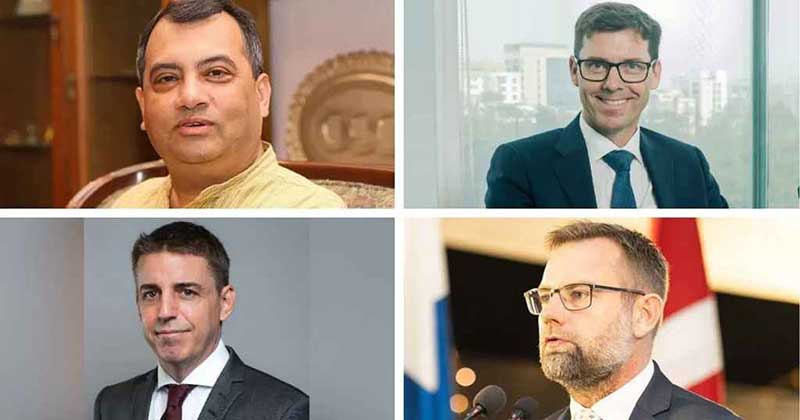

Amid heightened political tensions ahead of Bangladesh’s 13th National Parliamentary Election, three Nordic ambassadors—representing Norway, Sweden, and Denmark—held a secret meeting with former Environment Minister and senior Awami League leader Saber Hossain Chowdhury.
According to reliable diplomatic sources, the meeting took place on Monday (October 6) at Saber Hossain’s residence in Gulshan, Dhaka, and lasted for nearly two hours—from 2:55 PM to 5:00 PM.
Present at the meeting were Haakon Harald Gulbrandsen, Ambassador of Norway; Niclas Linnus Ragnar Wiik, Ambassador of Sweden; and Christian Brix Møller, Ambassador of Denmark.
Sources said the three ambassadors arrived in a single vehicle without diplomatic flags and left via an alternative route, an uncommon practice in diplomatic circles, suggesting the sensitive nature of the meeting.
Discussions reportedly centered on the Awami League’s future political direction, its potential participation in the upcoming national election, and possibilities for political rehabilitation following its ban. The ambassadors were said to have sought Saber Hossain’s views on how the banned party might re-enter mainstream politics, and how the international community might respond if credible, reform-minded Awami League leaders were allowed to participate.
The diplomats emphasized that ensuring a level playing field in the next election would require participation from all major political parties.
It may be recalled that the Awami League was banned in August 2024 following a mass student–citizen uprising that toppled the Sheikh Hasina-led government. Saber Hossain Chowdhury was arrested that October, facing six criminal cases including a murder charge, but was later released on bail.
Earlier, on May 11, Saber Hossain also held a private meeting with Tracy Ann Jacobson, the U.S. Chargé d’Affaires in Dhaka, where discussions similarly focused on the Awami League’s political rehabilitation and future strategy.
Norway, Sweden, and Denmark have long been key development and human rights partners of Bangladesh, particularly in the areas of climate change and governance—sectors in which Saber Hossain maintained close ties during his tenure as Environment Minister.
Political analysts believe this latest meeting was not merely a courtesy call, but rather part of broader international diplomatic efforts to influence Bangladesh’s future political trajectory.
Saber Hossain Chowdhury could not be reached for comment despite multiple attempts to contact him.