

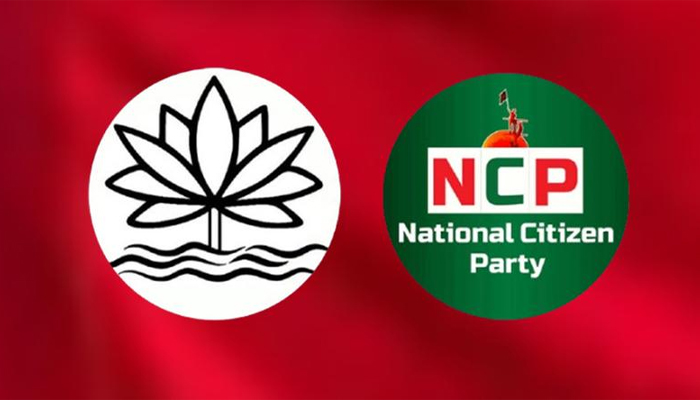

The National Citizen Party (NCP) has issued a detailed explanation on why it seeks the ‘Shapla’ (water lily) as its electoral symbol. On Friday, party leaders shared a nearly 1,300-word statement published under the name of its convener, Nahid Islam, on social media.
According to the statement, since the party’s inception, NCP leaders have held several meetings with the Election Commission (EC), where they were assured that the ‘Shapla’ symbol would be included in the final list of electoral symbols. On June 22, while applying for registration as a political party, NCP formally requested the allocation of ‘Shapla’ as its symbol.
However, on July 9, the party learned from media reports that the EC had made a policy decision not to include the water lily as an election symbol, arguing that it is a national emblem. NCP strongly rejected this reasoning, claiming that the commission’s explanation has no legal basis.
The party argued that under the Constitution, the 1972 Order on National Symbols, and related laws, there is no legal restriction on including ‘Shapla’ in the list of electoral symbols. Among the four elements of the national emblem, two—the paddy sheaf and the star—have already been allocated to political parties. Therefore, the water lily could also be lawfully used as a party symbol.
NCP accused the EC of being discriminatory and biased in its decision. Nahid Islam pointed out that while the police emblem prominently features a paddy sheaf, the Air Force logo includes an eagle, and the Supreme Court’s logo is entirely based on a scale of justice, those symbols were still allocated to BNP, AB Party, and Jamaat-e-Islami, respectively. Denying NCP the ‘Shapla’ symbol, merely because it resembles part of the DGFI logo, undermines the EC’s neutrality, he said.
The party further alleged that the decision reflects arbitrariness and favoritism, which could hinder democratic practices.