

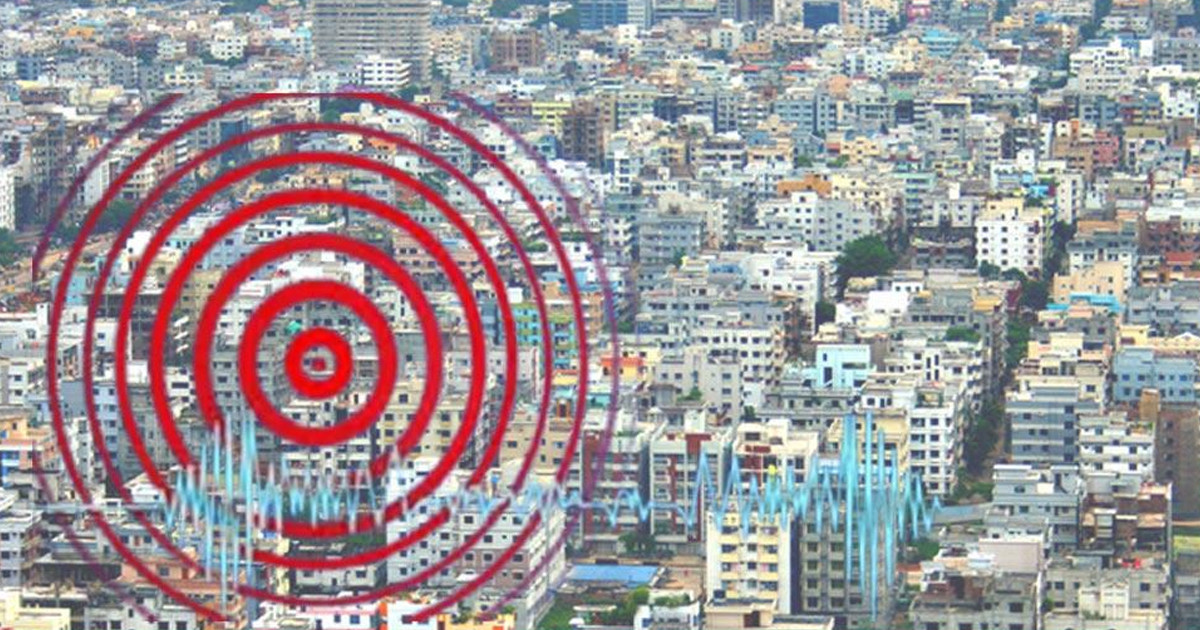

Experts are warning that Friday’s earthquake may signal a larger tremor in Bangladesh. According to seismologists, subterranean pressure is steadily increasing, creating conditions for a potential 6 to 9 magnitude earthquake.
Bangladesh sits at the junction of three major tectonic plates—the Assam Fault, the Dauki Fault, and Myanmar’s Sagaing Fault. Analysts say these faults are shifting, increasing the rate of underground energy accumulation.
Dr. Syed Humayun Akhtar, former geology professor at Dhaka University, explained that the Indian Plate is gradually subducting beneath the Burma Plate. GPS measurements show an annual compression of 1–1.5 meters. Energy equivalent to an 8.2–9 magnitude quake has already built up in the region.
Dr. Mehedi Ahmed Ansari, professor at BUET, noted that Friday’s quake had a depth of 10 kilometers and lasted about 20 seconds, serving as a warning for a larger future earthquake. Historical quakes in 1869, 1885, 1897, and 1918 highlight the region’s seismic vulnerability.
This time, the epicenter was within the country—Madhabdi, Narsingdi, just 13 kilometers from Dhaka—raising concern among experts.
Rubaiyat Kabir, head of the Seismology and Research Center at the Bangladesh Meteorological Department, said the northeastern regions (Sylhet, Mymensingh, Netrokona) are most at risk, central regions (Dhaka, Chattogram, Rangpur, Rajshahi, Cox’s Bazar) face moderate risk, and Khulna and Satkhira are comparatively safer.
Experts caution that smaller tremors can precede a major quake and urge citizens to check building safety and prepare for emergencies.