

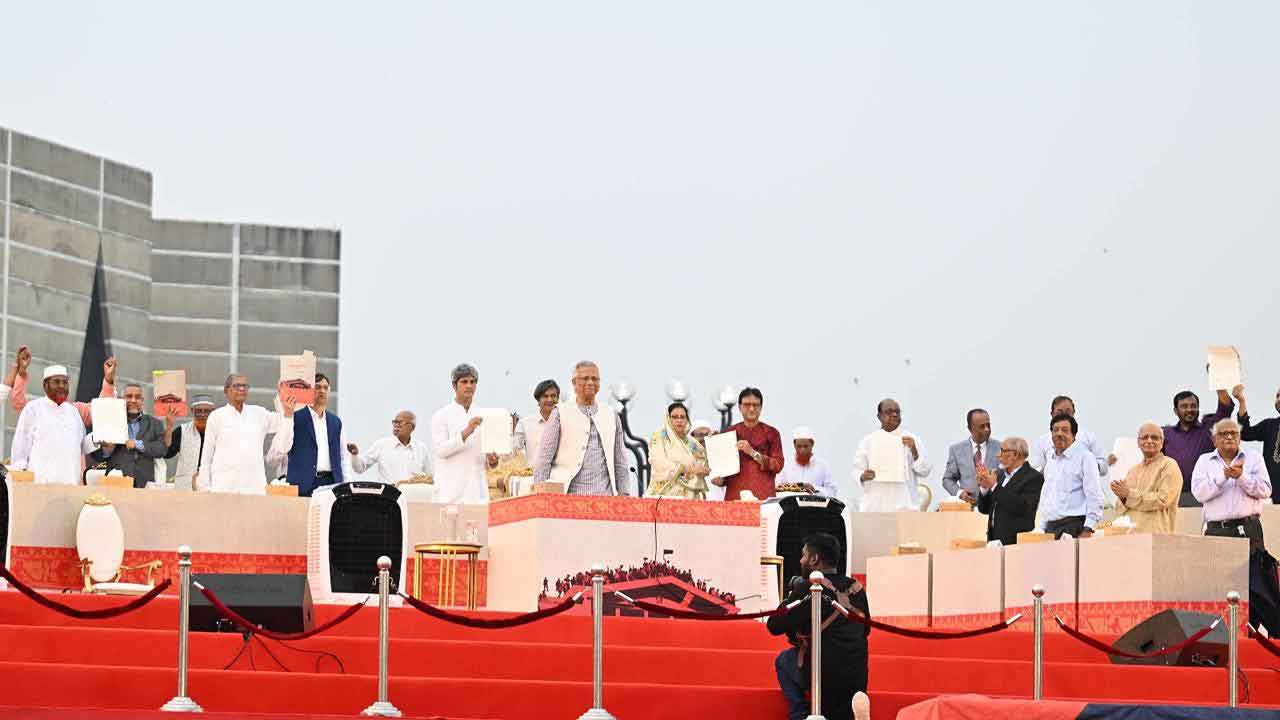

With pledges to restore democracy, uphold human rights, and reform state institutions, Chief Adviser Dr. Muhammad Yunus and leaders of major political parties signed the historic “July National Charter 2025.” The signing ceremony took place on Friday (October 17) at 5:00 p.m. at the South Plaza of the National Parliament Building.
A key component of the document is its Declaration of Commitment, which outlines the guiding principles for a new political direction in Bangladesh. Leaders of all major political parties also signed this declaration.
The charter—drafted in tribute to the sacrifice and bloodshed of the people during the July–August 2024 mass uprising—contains seven key commitments for rebuilding the state on democratic foundations.
The first commitment pledges the full implementation of the July National Charter 2025, recognizing it as the continuation of the people’s long struggle for democracy and freedom.
The second commitment states that the people are the true owners of the state, and their will is the supreme law. Reflecting the will of the people, political parties have accepted the charter and declared that it will be annexed to the Constitution as a formal schedule.
The third commitment declares that no court shall question the validity or necessity of the July Charter, and that full constitutional and legal protection will be ensured for its implementation.
The fourth commitment promises to provide constitutional and state recognition to the people’s 16-year democratic struggle against authoritarian rule, particularly the historic 2024 uprising.
The fifth commitment ensures justice for victims of enforced disappearances, killings, and torture, and pledges state honors for the martyrs, proper compensation and rehabilitation for the injured, and medical care for all victims.
This clause was amended following the demands of the July fighters, adding that the martyrs and injured from the uprising will be recognized as “National Heroes”, with monthly stipends, free healthcare, rehabilitation, legal immunity, and full protection of fundamental rights.
The sixth commitment focuses on comprehensive reforms in the Constitution, electoral system, judiciary, public administration, police, and anti-corruption frameworks, including the necessary enactment or amendment of laws and regulations.
The seventh and final commitment declares that the interim government will immediately implement all provisions of the July Charter that are ready for execution, without any delay.
The July National Charter 2025 is rooted in the July–August 2024 mass uprising, a defining moment in Bangladesh’s political history. During that time, thousands of citizens took to the streets against autocratic rule under Sheikh Hasina, state repression, economic mismanagement, and social injustice.
Over a thousand people were killed, and more than 20,000 were injured or permanently disabled during the movement. Eventually, on August 5, 2024, Sheikh Hasina fled the country and took refuge in India.
In this context, the July National Charter 2025 emerges as a new national compact—a pledge to rebuild Bangladesh as a democratic, just, and reformed state.