

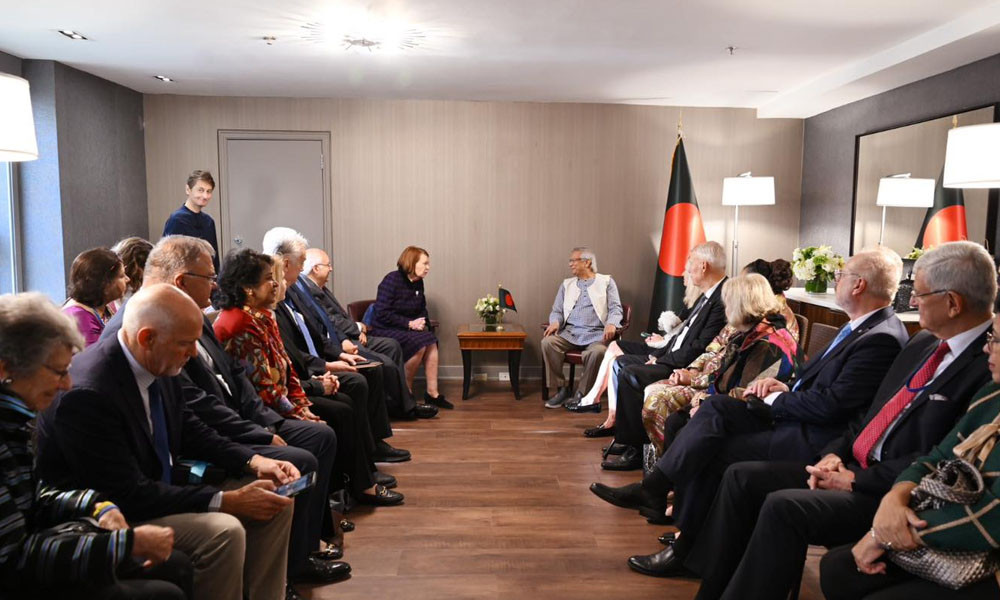

World leaders have expressed strong support for Chief Adviser Dr. Muhammad Yunus and his interim government. In a high-profile meeting at a New York hotel suite on Friday, several former heads of state and government voiced their confidence in his leadership and pledged all possible assistance during Bangladesh’s critical transition.
The meeting was chaired by former Latvian President Vaira Vīķe-Freiberga, who also co-chairs the Nizami Ganjavi International Center (NGIC). Among the distinguished participants were former Presidents Borut Pahor of Slovenia, Boris Tadić of Serbia, Egils Levits of Latvia, Rosen Plevneliev and Petar Stoyanov of Bulgaria, Ivo Josipović of Croatia, Mladen Ivanić of Bosnia and Herzegovina, and Ameenah Gurib-Fakim of Mauritius. Also present were former European Council President and Belgian Prime Minister Charles Michel, former Greek Prime Minister George Papandreou, the former Commonwealth Secretary-General, four past Presidents of the UN General Assembly, several ex–foreign ministers, former World Bank Vice President and NGIC co-chair Ismail Serageldin, Kerry Kennedy, President of Robert F. Kennedy Human Rights, and senior representatives from the IAEA and the Georgetown Institute for Women, Peace, and Security.
Speakers praised Professor Yunus for his lifelong contributions to poverty alleviation, social justice, and human rights. One leader stated: “We stand with you and the people of Bangladesh. You have our full support.” Some leaders pledged direct international aid.
Kerry Kennedy commended Bangladesh’s “remarkable progress” on human rights. Melanne Verveer, Executive Director of the Georgetown Institute for Women, Peace, and Security, announced that the institute would soon formally endorse Bangladesh’s July Revolution.
Overwhelmed by the unprecedented support, Dr. Yunus expressed deep gratitude, saying: “This is completely unexpected. To see you all come together and stand by us is truly extraordinary.” Comparing Bangladesh’s past 15 years of misrule to a “9.0 magnitude earthquake on the Richter scale,” he highlighted the challenge of managing public expectations with limited resources.
He stressed the need to fulfill the aspirations of the nation’s youth, who now envision a new Bangladesh, and called on the international community for guidance, support, and moral strength in the run-up to the general elections scheduled for next February.
SDG Coordinator Lamia Morshed was also present at the meeting.