

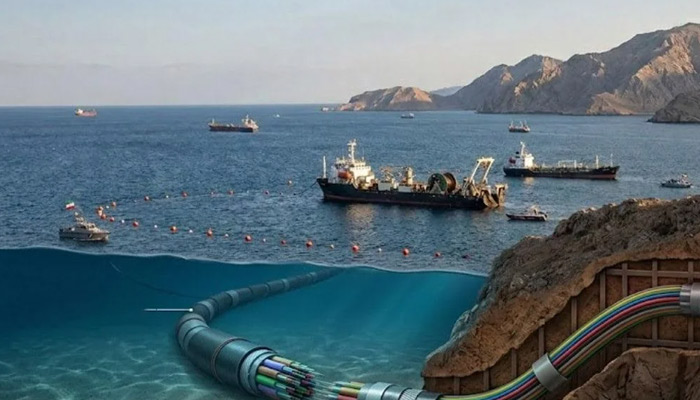

After strengthening its military and strategic influence in the Strait of Hormuz, Iran has now hinted at new plans surrounding the submarine cable network, a crucial part of the global digital communications system.
According to various international analysts, Tehran is taking a strategy to expand its influence over the submarine cable system that carries information and financial transactions between Europe, Asia and the Middle East via the Persian Gulf.
Iranian media and lawmakers are reportedly considering charging international technology and communications companies a license or transit fee for using submarine cables that cross Iranian waters in the future. Discussions have also begun in the country’s military and political circles.
According to experts, submarine cables are currently the backbone of the global internet system. International banking transactions, cloud services, military communications, online business, streaming platforms and a large part of digital information exchange are conducted through these cables. As a result, any instability in this infrastructure can have a major impact on the global economy and communication system.
Several Iranian military sources have claimed that international technology companies may have to comply with Iranian regulations in the future. At the same time, discussions are underway to give priority to local companies in cable maintenance and repair activities.
However, international law experts say that establishing sole control over undersea cable management is not easy. Because most submarine cables are operated under international maritime law and existing treaties. Especially in the case of imposing new restrictions on international waterways like the Strait of Hormuz, diplomatic and legal complications may arise.
According to technology analysts, Iran’s stance can also be seen as a strategy to create geopolitical pressure. In the context of ongoing tensions in the Middle East, the country is seeking to highlight its strategic importance in the global economy and communications system.
Security analysts have warned that damage to submarine cable infrastructure could not only disrupt internet services, but also have a major impact on international financial markets, energy trade, the outsourcing sector, and public-private communications.
Meanwhile, the international community is closely monitoring the situation. According to experts, future geopolitical tensions over the Strait of Hormuz could pose new challenges not only to energy security, but also to the security of global digital infrastructure.