

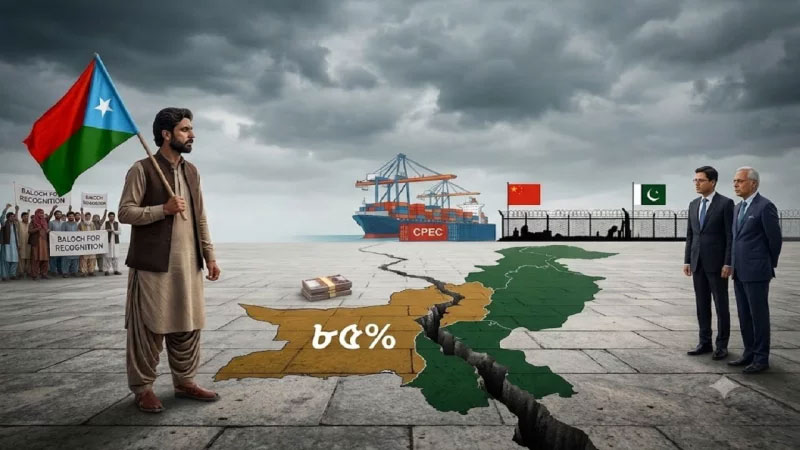

Balochistan, Pakistan’s largest province, has come under fresh discussion on a letter titled ‘Republic of Balochistan’ on social media.
The letter claimed that Balochistan is no longer part of Pakistan and that the pro-independence forces have already taken control of the region by about 85 percent. However, there has been no confirmation from an internationally recognized or neutral source in this claim so far.
The current situation is that the Pakistani government still retains administrative control of Balochistan. Although there have been long-standing clashes with separatist movements and security forces in the region, the declaration of an independent state does not mean that Balochistan has become a new country internationally.
To be recognized as a state under international law, four basic conditions of the Mont Video Convention of 1933 are required to be met. These are the capacity to manage permanent populations, specific terrain, effective governments and international relations. Despite Balochistan’s own population and ethnic identity, it is still a major challenge to achieve certain borders, effective state structures and international recognition.
According to analysts, the biggest obstacle is international recognition. To become a member of the United Nations, at least nine of the fifteen members of the Security Council must first have the support of at least nine countries and no country’s veto between the United States, the United Kingdom, France, Russia and China. Two-thirds of the UN General Assembly is also required to support.
The geopolitical reality of the independence of Balochistan is also considered a major obstacle. Pakistan is not willing to lose its largest province. At the same time, due to significant Baloch populations in Iran and Afghanistan, they may also oppose such initiatives. Beijing’s position is also crucial as China’s billion-dollar China-Pakistan Economic Corridor (CPEC) and the port of Gawad are located in Balochistan.
The example of history is different. South Sudan was recognized by an independent state through international support and political agreement. On the contrary, despite having its own government, army and strong economy, Taiwan is yet to receive the official recognition of most countries.
As a result, according to experts, the demand for publication or control of a letter is not equal to the establishment of an independent state. The path to Balochistan’s independence is still very complex without international recognition, effective state structure, and global political support.