

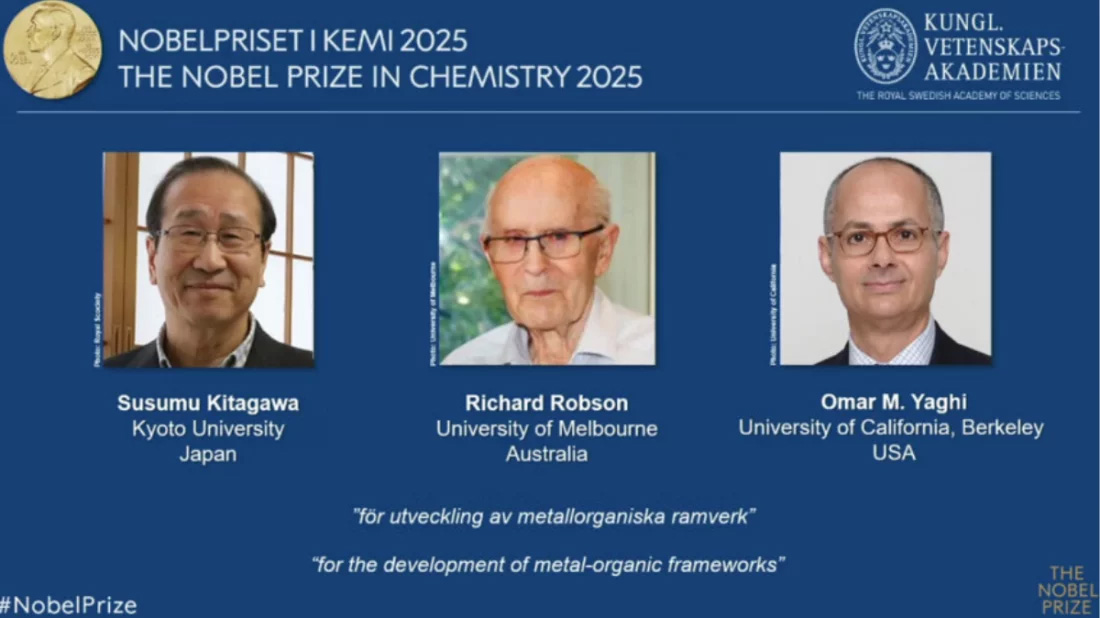

Three scientists have jointly won this year’s Nobel Prize in Chemistry for their groundbreaking work in developing “metal-organic frameworks” (MOFs). The laureates are Susumu Kitagawa of Kyoto University in Japan, Richard Robson of the University of Melbourne in Australia, and Omar M. Yaghi of the University of California, USA.
According to the Royal Swedish Academy of Sciences, the trio was honored for creating molecular structures with vast internal spaces that allow gases and chemical substances to pass through easily. These porous frameworks have revolutionized material and environmental chemistry.
The metal-organic frameworks can be used to extract water from desert air, capture carbon dioxide, store toxic gases, and accelerate chemical reactions. The structures are composed of metal ions linked by long carbon-based organic molecules, forming crystal-like materials filled with microscopic cavities.
Chemists can easily modify the composition of MOFs to design them for specific purposes—such as trapping targeted substances or conducting electricity.
Since the Nobel Prize’s inception in 1901, the Chemistry category has been awarded 116 times. The oldest laureate so far was John B. Goodenough, who won at the age of 97 in 2018. The youngest was Frédéric Joliot, who received the award in 1935 at just 35 years old.
The Nobel Prize, named after Swedish inventor Alfred Nobel, was established from his will, dedicating his fortune to honor outstanding contributions in Physics, Chemistry, Medicine, Peace, and Literature. In 1969, the category of Economic Sciences was added.